An FRP pipe fitting fails for one of three reasons: the resin was chosen without checking the actual chemical concentration, the laminate lacks a properly built corrosion barrier, or the dimensional tolerance does not match the joining method. In corrosive service, these three decisions determine whether the fitting lasts for years or fails within months. Get them right, and a glass-fiber-reinforced plastic fitting can outlast the carbon steel line it replaces; get them wrong, and you will be chasing leaking flanges at the first shutdown.
What FRP Pipe Fittings Are and When to Choose Them
An FRP pipe fitting is a molded composite component (an elbow, tee, reducer, coupling, or flange made of a polymer resin reinforced with glass fibers) that connects, redirects, or terminates a fiberglass piping system. Because the resin resists corrosion while the glass carries the mechanical load, the fitting can be tailored to a specific chemical service in a way cast metal cannot. That is why FRP fittings are the default choice for acidic fumes, brine, seawater, chlorine-bearing media, and industrial wastewater.
Comparison of FRP, carbon steel, and stainless steel fittings in corrosive service; actual results depend on the medium and operating conditions.
| Property |
FRP fitting |
Carbon steel fitting |
Stainless steel fitting |
| Corrosion resistance to acids and saline media |
Excellent with the correct resin |
Poor without a lining |
Good, but susceptible to chloride pitting |
| Weight relative to steel |
Roughly 1/4 to 1/3 |
Baseline |
Same as carbon steel |
| Typical service life in corrosive service |
15-25 years with correct resin selection |
2-5 years unless protected |
5-15 years depending on the medium |
| Maintenance profile |
Low; smooth surface resists scaling |
Frequent repainting and repair |
Low, but pitting can appear without warning |
The weight advantage matters more in practice than most buyers expect. A DN300 flanged FRP elbow weighs roughly a quarter of its carbon steel equivalent, which simplifies supports, rigging, and installation labor. The smooth inner surface also reduces friction losses and resists scale buildup in slurry or seawater lines. The trade-off is that FRP is a poor choice above roughly 150 °C, for hydrofluoric acid at significant concentration, or for lines that need frequent high-velocity steam purging; confirm the material with the resin manufacturer first. For a fuller analysis, our earlier comparison between FRP pipes and steel pipes covers the mechanical and economic differences in detail.
Key Specifications to Define Before You Order
Before asking for a price, put the service conditions on paper: the medium and its concentration, the design temperature and pressure, and the connection method. These four inputs decide the resin system, the wall thickness, and the joint design, and all four must be stated on the inquiry.
Resin selection
The resin is the first line of defense against chemical attack. A fitting is only as corrosion-resistant as its resin matrix, and each resin family has a different cost and temperature ceiling.
Resin families used in FRP fittings with approximate service ceilings; concentration limits must be confirmed against the resin supplier's data.
| Resin family |
Typical service |
Approximate temperature ceiling |
Relative cost |
| Orthophthalic polyester |
Water, mild chemicals, gas ducts |
60-80 °C |
Lowest |
| Isophthalic polyester |
Wastewater, moderate acids and alkalis |
80-100 °C |
Moderate |
| Vinyl ester |
Strong acids and alkalis, chlorides, oxidizing media |
100-120 °C |
Higher |
| Epoxy or novolac vinyl ester |
Solvents and high-temperature services |
120-150 °C and above |
Highest |
Dimensions, tolerances and standard
FRP fittings are generally ordered by nominal diameter matching the pipe standard used on the project. The manufacturing reference commonly cited is ASTM D5685, which covers the construction and performance requirements of FRP pipe fittings. Ask the supplier for three numbers in writing: the wall thickness at the hub, the flange face flatness, and the bolt-hole alignment of flanged ends. An out-of-flat face or misaligned bolt holes are the most common physical causes of joint leakage in flanged FRP systems.
Connection method and pressure rating
FRP fittings connect mainly by flanged, cemented, or butt-and-strap joints. Flanged connections are preferred for lines that must be opened for inspection, which is why most process lines above DN150 use flanged fittings. On pressure, note that FRP strength falls as temperature rises: a fitting rated at 1.0 MPa at 25 °C may only be acceptable at 0.6 MPa at 80 °C for the same resin, so compare pressure classes at the operating temperature, not at ambient. The flange drilling must match the standard on your piping, ANSI/ASME or DIN; send the drilling template if the line connects to existing equipment.
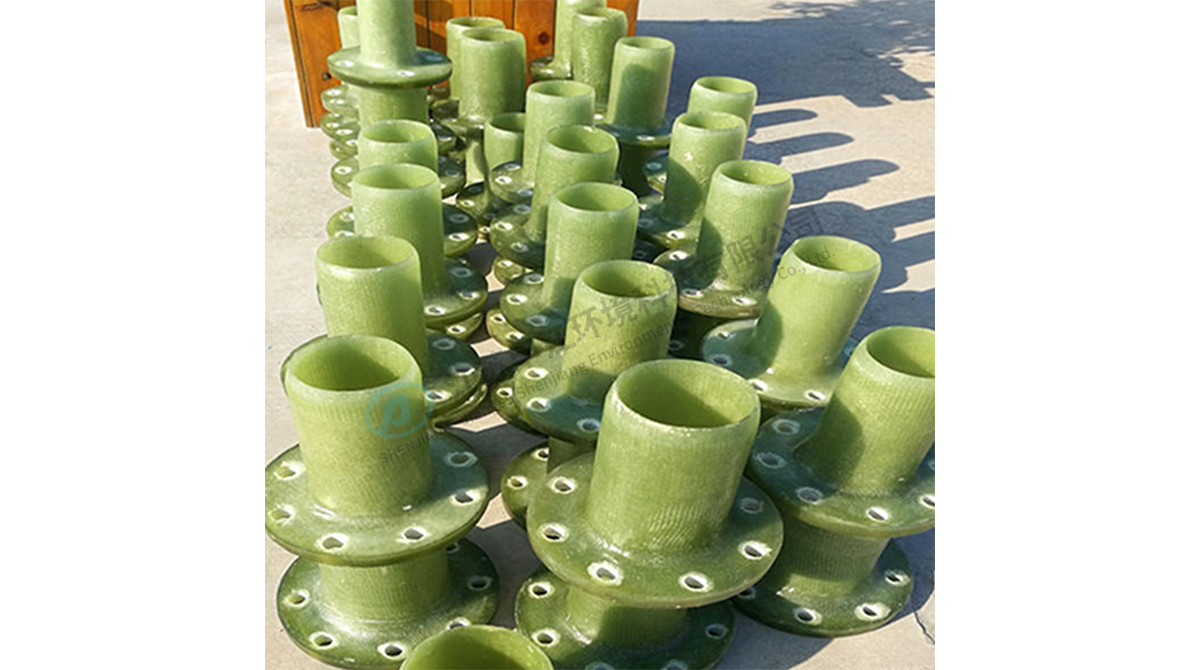 FRP Flanges for Corrosive Process PipingThese flanges suit lines that need periodic opening for inspection, especially above DN150. Their corrosion resistance and customizable materials make them a practical choice for harsh chemical and industrial service.View Product →
Common FRP Fitting Types and Where They Fit
A typical FRP piping layout uses only a handful of fitting shapes, and the choice comes down to pressure loss, available space, and the number of joints you want to maintain.
Elbows
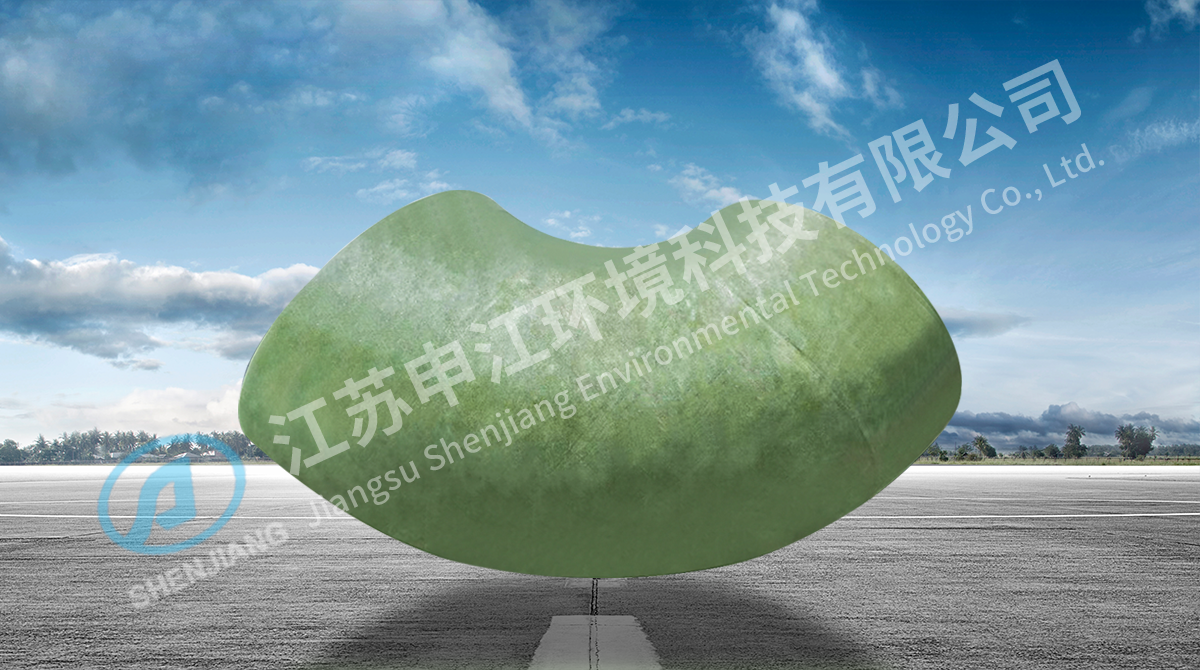
Ninety-degree and 45-degree elbows are the standard fittings for changing direction. In corrosive service, select the long-radius version whenever space permits. The larger centerline radius lowers pressure drop, reduces the bending stress on the fitting wall, and gives the flow a smoother path at the outer wall of the bend, which limits erosion in lines carrying abrasive slurries or high-velocity gas. As a guideline, the centerline radius of a long-radius 90-degree FRP elbow is typically 1.5 times the nominal pipe diameter.
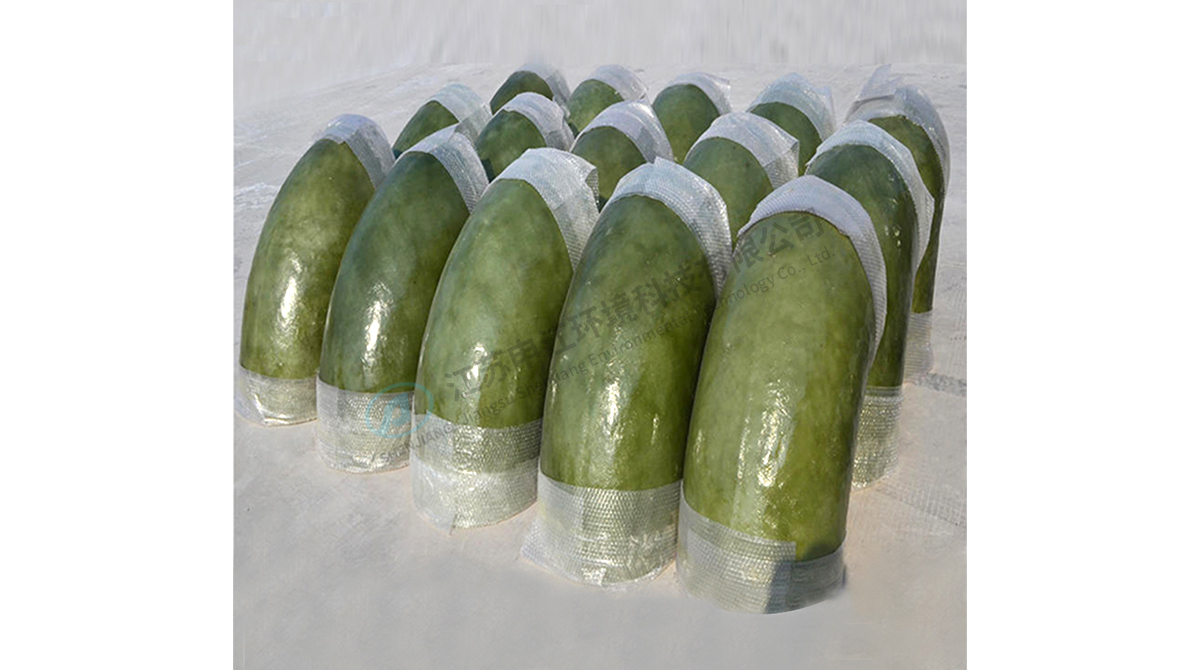 Long-Radius FRP Elbows for Direction ChangesElbows are essential for changing pipe direction, and the long-radius design reduces pressure drop and erosion in abrasive or high-velocity flows. The page highlights durable corrosion-resistant construction suitable for demanding environments.View Product →
Tees and bent tees
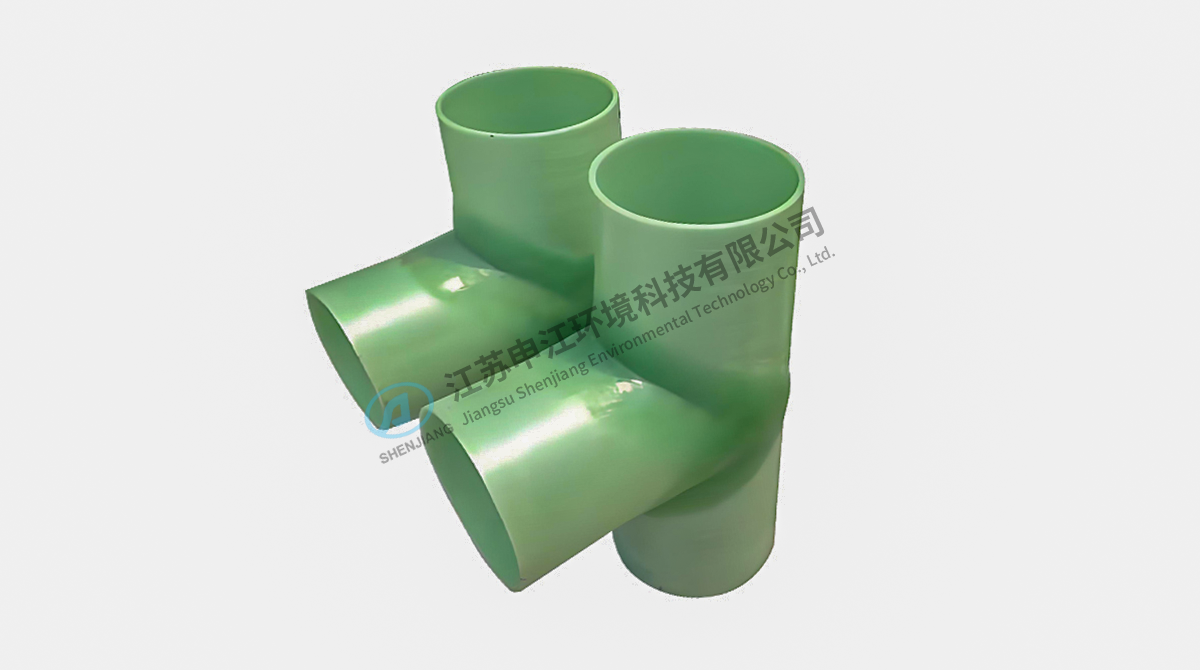
A tee joins a branch line to a main run. When the branch must also turn immediately after leaving the main line, a bent tee performs both functions in a single molded piece. Merging the tee and the elbow removes one joint and therefore one potential leak point, an advantage in concealed ducting or double-wall systems where access for repair is difficult. The same logic applies to reducing tees; confirm that the branch size reduction does not create excessive velocity in the branch flow.
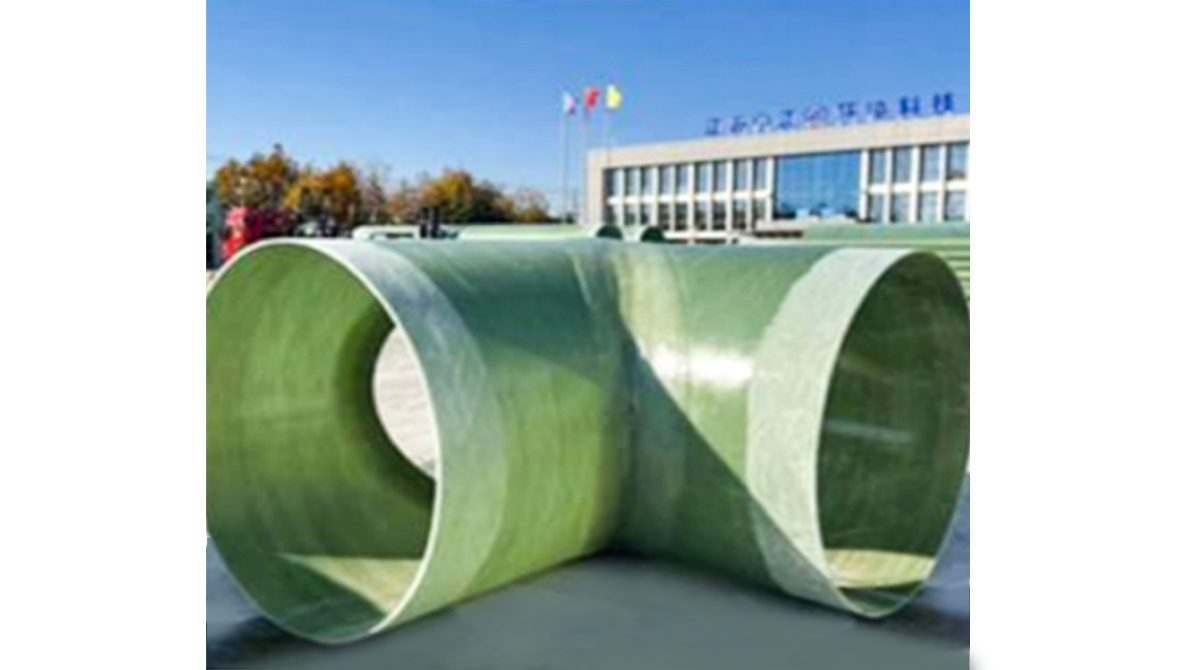 FRP Bent Tee Combining Branch and TurnThis fitting merges a tee and elbow into one molded piece, reducing joints and leak points in tight or concealed layouts. It offers corrosion resistance and customization for complex piping systems.View Product →
Reducers, couplings and flange parts
Concentric reducers connect different pipe sizes with a gradual transition, while eccentric reducers keep the bottom of the bore level, the right choice in slurry or gravity-flow service. Couplings join plain-ended pipe sections where the pipe will not be dismantled. Blind flanges, valve parts, and standpipes complete the isolation and draining points of the system and should be specified from the same material grade as the adjacent fittings to avoid differential expansion problems at the joints.
Manufacturing Quality: What to Inspect in a Fitting
Almost all FRP fittings are contact-molded rather than filament wound, because an elbow or tee cannot be wound economically. In contact molding, layers of chopped strand mat and woven roving are built over a mold by hand, and each layer is consolidated with rollers to remove air and wet out the fibers. The quality difference between suppliers comes down to how consistently that process is controlled and how carefully the corrosion barrier is built.
The corrosion barrier is a resin-rich inner layer, typically 0.25 to 0.5 mm thick, that contains a C-glass or synthetic veil. It has no structural function; its only job is to prevent aggressive media from reaching the glass reinforcement. If this layer is thin or damaged, chemicals wick along the fibers and delaminate the wall from the inside, often before external signs appear. When you receive fittings, confirm the barrier thickness in the documentation and check that cut openings were edge-sealed with the same resin.
- Ask for a cut cross-section of a sample to verify barrier thickness and layering before a large batch is delivered.
- Inspect machined edges for exposed glass fibers; fibers at flange faces or cut ends mean the resin-rich edge seal is missing.
- Tap test the body and flange hub; a dull response indicates incomplete cure, which will creep under bolt load.
- Place the flange face on a flat surface plate and check for rocking; any gap becomes a leak path once the gasket is compressed.
- Confirm the certificate lists resin type, barrier thickness, and the pressure rating at your operating temperature.
How to Qualify a Supplier for FRP Fittings
A fitting is only as reliable as the process control behind it. Ask prospective suppliers how they control the resin-to-glass ratio, how they verify cure, and whether they will put the laminate schedule and barrier thickness in writing. A manufacturer that designs its own laminates, produces its own FRP piping and fittings, and has installed the material in the field is easier to hold accountable than a reseller of imported mouldings.
Our company has designed and manufactured resin-based composite products since 1996, and the engineering team applies the same laminate design logic to fittings that it uses on complete industrial gas treatment systems. Our company profile describes the production facilities, engineering headcount, and quality-control capabilities behind our FRP piping and fittings. When comparing quotations, weigh documented experience as heavily as unit price; a fitting that costs 10 percent more with a verified resin system and a written pressure-temperature guarantee is cheaper over its service life than a low-price part that fails at startup.
Specifying FRP pipe fittings does not require a degree in composite engineering, but it does require discipline. Define the service conditions first, choose the resin from those conditions, confirm the corrosion barrier and laminate in the manufacturing specification, and verify the flange face and tolerances before the fittings ship. Send the supplier your process data sheet rather than a bare size list, and ask them to confirm the resin system and pressure-temperature rating in writing. The minutes spent on those steps cost far less than a failed joint in a line that cannot be shut down.




 English
  中文简体
中文简体 Español
 عربى
عربى русский
 ไทย
ไทย Indonesia
 Tiếng Việt